



The ANZAC oration – We will remember them
The ANZAC oration on Thursday 1 May presented by Dr Katti Williams (Wyvern 1994) and Philip Powell, past student and Fellow of Wesley College, opened fittingly with the Queen’s choir, led by Director of Music, Will Fellows, singing Edward Elgar’s, ‘We will remember them’.
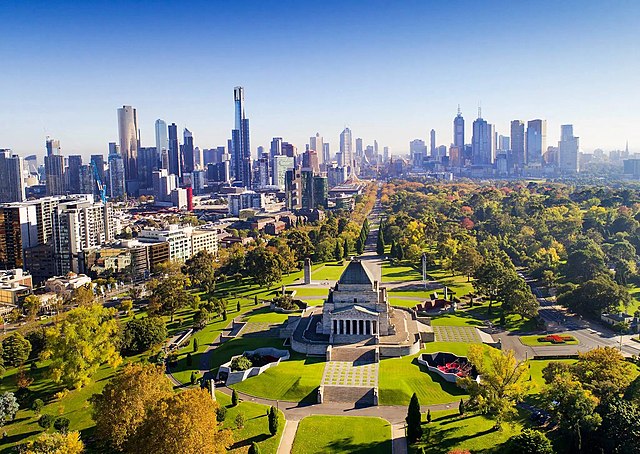
Katti gave an engaging and enthusiastic presentation on the architects who designed Melbourne’s Shrine of Remembrance, showing how the returned-soldiers’, Philip Hudson and James Wardrop’s, military service impacted their thinking when designing the iconic landmark. Hudson and Wardrop used classical references in their design also, being inspired by the Mausoleum at Halicarnassus – one of the Seven Wonders of the Ancient World.
Katti’s PhD thesis comprised the first sustained academic study of the Australian early 20th century architect, William Lucas, whose design for the Shrine came runner-up to Hudson and Wardrop’s. Not pleased with the result, Lucas gained a reputation as one of the sorest losers in architectural history, accusing the winners of plagiarism.
Katti shared sketches Wardrop had drawn during the first world war, previously unseen beyond his family, and a letter from Hudson to his wife showing his grief at the loss of his two younger brothers in the war.
Katti reflected, “Had Lucas’s design won, Melbourne’s war memorial would have been a free design of a theatre, featuring a large circular plaza, with a raised block in the centre, to be the tomb of the Unknown Soldier. A large monumental form with an archway was to enclose a seat of remembrance, where he planned pilgrims could sit to contemplate the tomb. The entire site was to be on the raised area at the corner of Flinders and Exhibition streets with a clear view of the bay, referencing the waters by which the ANZACS departed and returned home.”
Initially, Hudson wanted the Shrine to be empty but changed his mind, thinking that it needed to embody a soul. Katti found this to be a very perceptive response to the nature of Australian grief which is characterised by absence and distance. The absence of the dead and the distance from their graves.
“The Shrine has maintained its appeal largely because of the interior space, as it brings an exquisite pang of realisation. Rather than an empty tomb, they alluded to a tomb, by centering the stone of remembrance, sinking it below floor level, ethereally lighting it from above, they gave the visitor the feeling they are approaching a grave but there is no grave, just a simple stone bearing the inscription, ‘Greater love hath no man.’ A truly powerful, poignant reminder of the absence of the Australian dead.”
Katti’s address was well matched by Philip Powell’s stories of some of the former Queen’s College and Wesley College students’ who were lost as a result of military service.
Forty-six deaths are recorded in the Queen’s College chapel for the two world wars, 31 from WW1, 15 from WW2, with 21 of them past students from Wesley too.
Sam Ettingove (Wyvern 1917) buried in the Brighton cemetery, died 20 May 1918, was studying law, when he enlisted in early 1918.
Philip said, “That was a brave thing to do because in 1918, you knew you were going to the Western front, a pretty hideous environment. Unfortunately, while in training camp he was killed in a motorbike accident, on Glenferrie Road. He was born in Belarus and he and his cousin decided to come to Australia a few years before the war. Their mutual uncle was Sidney Myer. The cousin he came out with was Sir Norman Myer.”
Philip spoke of Edward Smith (Wyvern 1938).
“He died on 22 July 1942 in the first battle of El Alemein, where he is buried. The inscription on his gravestone, chosen by his family is, ‘He did his best.’ He had come from Warragul, a bright young lad who had received scholarships to go to Wesley. When he came to Queen’s he studied Arts and Law, and received University of Melbourne Blues in football and cricket.”
Philip shared the story of Waldo Warne-Smith MC (Wyvern 1913).
“He died 20 September 1918, in the hospital in Rouen, of the wounds he received when he took out a machine gun post. He and both his brothers served, one died and the other, Ivor was the first person to win two Brownlow Medals, and also captained the Melbourne Football Club to a premiership.”
The ANZAC oration gave all who attended the chance to pause, reflect, and remember them.